The DoSEL showcase in Valletta highlighted European theatres’ ongoing longing for human interaction and databases
25.06.2026 13:17
In April, Valletta, Malta, hosted the showcase for the international project DoSEL – Drama of Smaller European Languages, which featured productions based on dramaturgy written in smaller languages, including Mart Kangro’s “MEDIUM” (Von Krahli Theater and OÜ Olevik) from Estonia. As a member of the Estonian delegation, theatre critic Johanna Rannik also attended the festival – hereby, we are publishing her review of the event.
From April 16th to 22nd, partners in the international project DoSEL – Drama of Smaller European Languages – gathered for their second showcase to discover, compare, and analyse plays written in smaller languages – as well as their translation and staging. The project stems from a shared desire within the European theatre community to arrange more face-to-face meetings and to make dramaturgy in their own languages more visible and mobile on an international level. This time, the gathering took place in Valletta at the invitation of Teatru Malta, and the program included productions from Malta, Slovenia, Croatia, and Estonia.
It is my personal belief that a sense of otherness is inherent in the creative work of small cultures, something that can be perceived even when the art itself does not aim to be thematically political; however, this perspective has so far been based mainly on my theatre studies, archival materials, and conversations with foreign colleagues. So, naturally, I jumped at the opportunity when the Estonian Theatre Agency wrote to me and asked whether I would like to join the delegation as a theatre critic.
In addition to the evening performances (and post-performance discussions), numerous roundtables and meetings were held throughout the festival week for both the participants in the translation residency and those responsible for project management, communications, and other tasks related to the participating theatres. Unfortunately, I do not belong to either group – the festival team’s meeting rooms remain closed to delegates. Nevertheless, the program for “regular delegates” was also very packed: among other things, there were public readings of existing play translations (including Piret Jaaks’ “Can Animals Count?”), a meeting with the director of the Spazju Kreattiv creative centre, and a panel discussion on the potential and future of using artificial intelligence in drama translation. In this brief overview, I will focus mainly on the performances, but since I also had the opportunity to speak with representatives from all the countries participating in the project, I will share some other observations as well.
Malta
The festival opened with Teatru Malta’s production of “Ir-Rebħa tal-Ħuta Li Ttir” (“The Triumph of the Flying Fish,” directed by Philip Leone-Ganado), a play by Carmel S. Aquilina. The play is inspired by the Greek soldiers’ revolt against British colonial rule, which took place at Fort Ricasoli in 1807. As a parallel to the revolt and its tragic suppression, the inner world and perspectives of the main character, a British girl named Constance, unfold: she begins to hide Elias, a participant in the rebellion, who makes her realise that in the context of colonisation, one cannot speak of a so-called “benign ruler” or “good” and “bad” colonial power. Constance’s entire world up to this point is figuratively – and literally – blown to pieces.
The introduction I read before the performance promised an extremely intriguing political production that weaves together themes of colonial legacy and political resistance with religion, myth, empire, and identity – I was excited, already imagining how we could stage this in Estonia. Alas, the sheer abundance of themes became the production’s main obstacle: during the post-performance discussion, the director admitted that the production was essentially two plays in one and that he was considering staging them separately in the future. The audience was treated alternately to a Chekhovian salon conversation among British colonists (with very minimalist stage and sound design) and to a passionate exploration of memory politics and deep-seated emotions.
Unfortunately, “Ir-Rebħa tal-Ħuta Li Ttir” will not have time to mature in subsequent performances, as it appears to have been a production developed specifically for the festival. This choice leaves me confused, as the program notes listed Carmel S. Aquilina as one of Malta’s most important directors and playwrights – so why not do additional performances? The discussion, however, was very professionally moderated and substantial: in Estonia, the audience is normally given 10–15 minutes between the performance and the discussion to reflect and stretch their legs, whereas the discussion of “Ir-Rebħa tal-Ħuta Li Ttir” began immediately as the curtain fell. Far more people participated in the discussion than I had expected, and the moderator’s insightful questions and analytical comments highlighted the strengths of the production and the cast – which certainly had a positive impact on the overall experience.
Slovenia
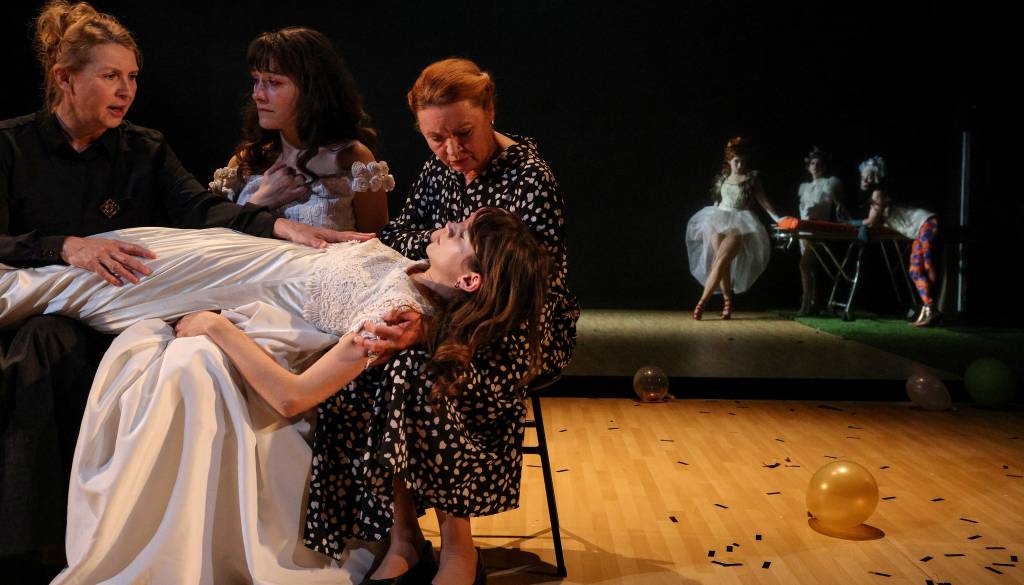
A small-town theatre with a keen sense of social issues, The Prešeren Theatre from Kranj, Slovenia, presented Anja Novak’s play “The Text of the Body,” directed by Tjaša Črnigoj. Three women from one family – a daughter, a mother, and a grandmother – reveal, through their bodily experiences, both personal traumas and the era in which they grew up. The body is repeatedly referred to as a separate entity, yet the source of this detachment differs for each woman. The grandmother and her contemporaries are defined solely through their role as mothers; the body is an incubator, and any other sexual dimension (especially one that is not heteronormative) is entirely excluded from discussion. Over the course of twelve years, the character had given birth to five children and experienced postpartum depression, but due to a lack of knowledge, treatment options, and community support, this meant only ever-deepening loneliness. One of these five children, the play’s mother figure, is a victim of sexual violence but decided not to have an abortion because “good mothers don’t have abortions.” This dialogue is staged as a podcast conversation between the mother and daughter, which, contrary to expectations, offers a healthy dose of alienation, as such honesty between them would hardly have occurred in real life. Likewise, the daughter’s response to the above: “And are you a good mother, then?”
The daughter herself is also a victim of rape, and in the wake of the trauma, she has developed anorexia. Her constant struggle and lack of control over her thoughts and body are illustrated on stage by the fact that the Body is portrayed as a separate character who, at the end of the production, tragically succumbs to their struggles at the age of 26. The metaphors used in the play would seem somewhat overused in Estonian feminist performing arts today (e.g., “the body is a mosaic of experiences”), but both the cast and the audience were visibly moved after the performance. During the discussion, Novak mentioned that the play is based on her personal experience, and the troupe also described how it was at times difficult to establish a boundary between themselves and the text. A delicately handled and clearly important, long-awaited exploration of a theme relevant both in Slovenia and elsewhere.
Croatia
The Croatian National Theatre’s “Always Be Like a Dragon” (written by Espi Tomičić, directed by Olja Lozica) examined not only body politics but also the long-term, crushing impact of poverty and mental health disorders. It is noteworthy, however, that the psychological (internal) conflict is explicitly juxtaposed in the production with human rights tragedies unfolding in Gaza, Mariupol, and elsewhere. Since so many core themes are tackled within a single production, some of them remained underdeveloped by the end (as was the case with the Maltese production). For example, the main character, Peter, is a trans man whose family background is revealed to us through flashbacks that he analyses in therapy. When Peter returns home after a long absence, his relationship with his mother is already fraught with conflict and tension; the characters focus more on their childhood and gender identity takes a backseat. At the same time, this didn’t bother me once the performance ended – on the contrary, “Always Be Like a Dragon” was my favourite piece from the DoSEL presentation festival’s repertoire.
The audience was seated on the large stage of Teatru Manoel, with the view of the auditorium obscured by kraft paper walls. The troupe also delivers an intense musical score, which is thankfully also given opportunities to shine as a solo element rather than merely serving as background. In addition to the performers, there are two professional musicians on stage (Sara Renar and Dimitrije Simović), whose technical mastery captured the entire audience’s attention on more than one occasion and provided continuity during moments when the text became too fragmented. Endless arguments with mounting tension, the unexpected hysterical outbursts of a traumatised person, and political monologues can oftentimes veer into insincerity and melodrama on theatre stages, but they can also be deeply moving. Such was the case here.
The Croatian National Theatre troupe is sensitive and attentive on stage, and I would gladly get to know their other roles as well (it seems I’ll have to go to Zagreb). Based on my experience so far, I still count myself among those who enjoy experiencing the grim and the heavy in a rather direct form. Among Estonian productions, I would compare “Dragon” to, for example, “The Tin Drum” in Estonian Theatre for Young Audiences and the Tallinn City Theatre’s “Krum”, which also succeed in mixing in the political topics that are usually more present in the works of contemporary performing artists.
Estonia
The festival culminated with Mart Kangro’s “MEDIUM”. It was the only solo performance in the program; also, I would consider it the only production in the genre of contemporary performing arts. The formal distinctiveness was emphasised by the black-box-like minimalism of Teatru Manoel’s stage; the audience sat facing the auditorium, right on the stage itself. A large velvet curtain occasionally reminded us, however, that on the other side were balconies adorned with gilded carvings. During the week spent in Malta, the Estonian delegation heard on more than one occasion that the performance of “MEDIUM” was highly anticipated (or even the most anticipated of all) – it was certainly a proud moment. The source of the Slovenian delegates’ excitement was reportedly “Fun Fact,” which was also performed in Ljubljana; as for the other delegates, I assume it was precisely the aforementioned difference that sparked their curiosity.
One of the inevitable aspects of international festivals, at least for now, is the roughness of the translation (I would even dare to challenge AI enthusiasts to tackle this problem). Subtitles stay more true to the original text and can be more detailed, but all too often the technology fails: the subtitles lag behind the text being spoken on stage or get completely out of sync. Fortunately, simultaneous interpretation is becoming less common (there are certainly theatres that offer high-quality simultaneous interpretation, but I haven’t experienced it yet). Since “MEDIUM” is a production that relies heavily on wordplay, Kangro performed it in English. At a dramaturgy festival for small languages, hearing other languages is certainly part of the charm, but this solution also seemed best from the audience’s perspective, as “MEDIUM” is built on Kangro’s physicality, presence, and connection with the audience, not just the sound of the language. Moreover, there were problems with the subtitles at both the Slovenian and Croatian performances (in the former, the translation disappeared right at the punchline). Having now heard the production in two languages, the wordplay and references to politics and pop culture are, of course, clearer to an Estonian audience, but they also came across in Valletta.
A play that only an Estonian could have written
It was surprising to discover during the festival, through both conversations and performances, that the participating countries perceive the role of their native language quite differently in the context of both dramaturgy and cultural identity. The general view seemed to be that, rather than directly reinforcing national identity through dramaturgy in one’s own language, addressing universal themes and critically examining identity are considered more important. As I watched the program, themes of body politics and questions of otherness stood out to me, but my conversation partners representing theatres from various European countries tended to disagree (noting, incidentally, that my view is typical of that of a theatre critic).
Representatives of Basque and Catalan theatres inevitably attribute a different significance to the existence of theatre in their own languages than do countries whose national identity is firmly established. For them, promoting their own dramaturgy also carries a dimension of cultural and political self-assertion, as a strong and distinctive national identity (of which culture is an essential part) is one of the clearest examples of soft power. Soft power, in turn, is a way to legitimise statehood and ensures the sustainability of the national movement. Nevertheless, the Basques and Catalans also emphasised, above all, the need to introduce their authors to the international arena and create new opportunities for them to work and collaborate.
The question, however, is whether the current festival format is the best way to showcase plays written in different languages. If I were a theatre director or literary editor visiting the festival in the hope of finding fresh and compelling foreign plays, I would certainly meet many helpful colleagues, but the specific plays being developed within the project for international marketing purposes remained rather abstract. They were presented on April 19th at a public reading, performed by actors from Teatru Malta. The excerpts presented were very short and ultimately merged into a single, somewhat difficult-to-follow mass of text. The program had allocated three hours for the reading, but for some unknown reason, the event was half as long – I would have gladly delved deeper into each play. It certainly would have been helpful to have physical, visual materials, such as a list of the plays to be performed and their authors. As a delegate, I did get acquainted with the dramaturgy of other countries, but it is quite difficult to decide, based on a single production, whether to get further acquainted with the database of the rest of the plays from that country (assuming it exists).
In my opinion, DoSEL is an admirable initiative, and according to the participants, its greatest benefit has been meeting face-to-face and comparing theatre models. For example, it became clear that not all countries have a shared, public database of plays – the Estonian Theatre Agency’s contribution to the accessibility of dramaturgy should not be taken for granted. Regular meetings help develop a functioning pan-European theatre network (the network does exist, but members rarely actually meet in person), and this would likely also lead to collaborative productions, international tours, and the like. However, festivals with a comprehensive program like the Estonian Theatre Festival DRAAMA seem more effective today for getting to know the dramaturgy of fellow project partners.
Johanna Rannik
Photo from the performance “The Text of the Body“ by Prešeren Theatre Kranj. Photo by Borut Bučinel